You wake up tired.
You go through the day feeling drained.
Even simple tasks feel heavier than they should.
And the worst part?
👉 You didn’t even do anything physically exhausting.
This is not just “tiredness.”
This is mental fatigue—and it’s becoming one of the most common problems in modern life.
But here’s the truth most people don’t understand:
You’re not tired because you’re doing too much.
You’re tired because your brain is overloaded in the wrong way.
In this article, you’ll understand the science behind mental exhaustion, what is really draining your energy, and how to restore your focus, clarity, and motivation.
The Science of Mental Fatigue (What’s Happening in Your Brain)
Mental fatigue is not just a feeling—it’s a neurological state.
Your brain consumes about 20% of your body’s energy, even though it represents only a small portion of your total weight. When you are constantly making decisions, switching tasks, or processing information, your brain uses significant cognitive resources—especially in the prefrontal cortex, the area responsible for focus, planning, and decision-making.
Over time, this leads to something called cognitive overload.
Research in neuroscience shows that when the brain is overloaded:
- Decision-making becomes slower
- Focus decreases
- Emotional control weakens
- Motivation drops
This is why, after a long day of “thinking work,” even small decisions feel exhausting.
The Hidden Cause: Decision Fatigue
One of the biggest contributors to mental exhaustion is something called decision fatigue.
Every day, you make hundreds (sometimes thousands) of decisions:
- What to eat
- What to wear
- What to respond
- What to prioritize
Each decision consumes mental energy.
Psychologist Roy Baumeister, known for his research on self-control, demonstrated that the more decisions you make, the worse your decisions become over time.
This concept is also explored in depth in
👉 Thinking, Fast and Slow
Kahneman explains that your brain operates in two modes:
- Fast thinking (automatic)
- Slow thinking (effortful and energy-consuming)
The more you rely on slow thinking, the faster you become mentally exhausted.
Why Modern Life Is Draining You
The problem isn’t just workload.
It’s how your attention is being used.
Today, your brain is constantly:
- Switching between tasks
- Processing notifications
- Consuming information
- Responding to interruptions
This creates what scientists call attention residue—a phenomenon where part of your attention stays stuck on the previous task, reducing your ability to focus on the next one.
This concept is widely discussed in cognitive performance research and helps explain why multitasking feels so draining.
You’re not tired because you worked too hard.
You’re tired because your attention never truly rested.
Real Example: How High Performers Protect Their Energy
Consider Barack Obama.
During his presidency, he deliberately reduced the number of daily decisions he had to make. He wore only a limited set of suit colors and simplified his routines.
Why?
To preserve mental energy for important decisions.
Another example is Mark Zuckerberg, who adopted a similar approach with minimal wardrobe choices.
These are not coincidences—they are strategies based on cognitive efficiency.
The Energy Myth: Rest Alone Is Not Enough
Most people try to fix mental fatigue with rest:
- Watching TV
- Scrolling social media
- Doing “nothing”
But here’s the problem:
👉 Not all rest is real recovery.
Passive consumption often keeps your brain stimulated, instead of allowing it to reset.
This is explained in
👉 Rest: Why You Get More Done When You Work Less
The book highlights that true recovery comes from:
- Deep rest
- Mental disengagement
- Intentional breaks
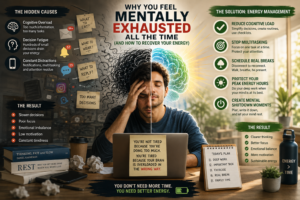
The Real Solution: Energy Management (Not Time Management)
You don’t need more time.
You need better energy.
Let’s break down how to restore it.
1. Reduce Cognitive Load (Simplify Your Life)
The more decisions you remove, the more energy you preserve.
Practical strategies:
- Plan meals in advance
- Create a fixed routine
- Use checklists
- Limit unnecessary choices
Even small simplifications reduce mental fatigue significantly.
🧠 Exercise:
Today, eliminate 3 unnecessary decisions.
Example:
- Decide tomorrow’s outfit now
- Plan your first task in advance
- Predefine your meals
Notice how lighter your day feels.
2. Stop Multitasking (It’s Draining You)
Multitasking is one of the biggest sources of mental exhaustion.
Every time you switch tasks, your brain must:
- Refocus
- Reprocess context
- Rebuild attention
This consumes energy.
Replace multitasking with:
- Single-tasking
- Focus blocks
- Clear task boundaries
One focused hour is more powerful than three distracted ones.
3. Schedule Real Breaks (Not Fake Ones)
Scrolling is not rest.
It’s stimulation.
Real recovery activities:
- Walking without your phone
- Sitting in silence
- Light stretching
- Being in nature
These reduce cognitive load and restore mental clarity.
4. Protect Your Peak Energy Hours
Your brain is not equally productive all day.
Most people have peak cognitive performance windows (often in the morning).
Use that time for:
- Deep work
- Important tasks
- Learning
And leave low-effort tasks for later.
5. Create “Mental Shutdown” Moments
Your brain needs a clear signal that the day is over.
Without this, it keeps processing tasks—even during rest.
Simple ritual:
- Write down unfinished tasks
- Plan tomorrow
- Close your workspace
This reduces mental carryover and improves recovery.
Real Story: Burnout vs. Recovery
Many professionals experience burnout not because they work too much—but because they never disconnect.
A common pattern:
- Constant work
- Constant phone use
- No real rest
Once they introduce:
- Structured breaks
- Focus blocks
- Reduced stimulation
Energy returns surprisingly fast.
Final Thoughts
You’re not weak.
You’re overloaded.
Your brain was not designed for constant input, endless decisions, and continuous stimulation.
But the good news is:
👉 You can reset it.
By simplifying your life, protecting your attention, and prioritizing real recovery, you regain something most people are losing:
Clarity.
Energy.
Focus.