
You sit down to work.
Open your laptop.
Start a task.
And within minutes…
You’re checking your phone.
Again.
This isn’t laziness.
It’s not lack of discipline.
👉 It’s a trained brain.
Your brain has been conditioned to avoid effort and seek stimulation. And unless you understand how this works, focus will always feel like a struggle.
In this article, you’ll learn:
- Why your brain resists focus
- The science behind distraction
- How high performers train deep concentration
- A practical system to rebuild your focus
The Real Problem: Your Brain Is Wired for Survival, Not Focus
Your brain evolved to:
- Detect threats
- Seek rewards
- Conserve energy
Not to:
- Study for hours
- Work deeply
- Avoid distractions
From a neuroscience perspective, your brain is constantly asking:
👉 “What’s the easiest way to feel good right now?”
That’s why:
- Scrolling beats studying
- Notifications beat deep work
- Comfort beats effort
The Dopamine Trap (Scientific Explanation)
Dopamine is often misunderstood.
It’s not the “pleasure chemical.”
👉 It’s the motivation chemical.
Research in neuroscience shows that dopamine spikes before action, not after. It drives anticipation.
This means:
- Your brain gets excited about checking your phone
- Not necessarily using it
This concept is deeply explored in
👉 Dopamine Nation
What’s happening today:
Modern life gives you:
- Instant rewards
- Constant novelty
- Endless stimulation
This overloads your dopamine system.
Result:
- Lower baseline motivation
- Less focus
- More distraction
Why Focus Feels Harder Than Ever
Let’s make this simple:
The more stimulation you consume, the less focus you have.
Your brain adapts.
If you constantly consume:
- Short videos
- Fast content
- Notifications
Your brain loses tolerance for:
- Silence
- Effort
- Depth
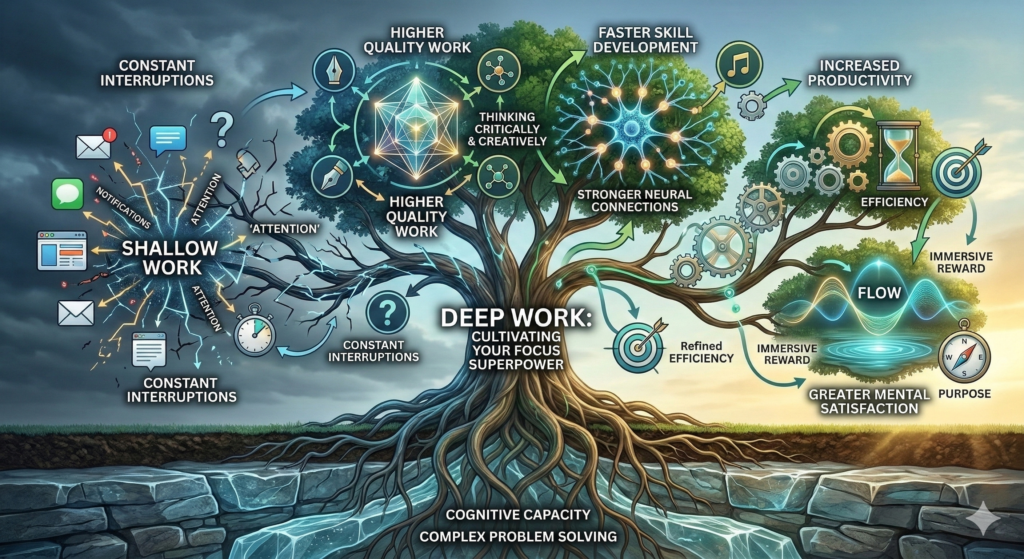
Real Example: How Top Performers Protect Focus
Take Cal Newport, author of
👉 Deep Work
He built his career around one principle:
“The ability to perform deep work is becoming rare—and valuable.”
He avoids:
- Social media
- Constant notifications
And schedules uninterrupted focus blocks.
Another example: Bill Gates
He famously created “Think Weeks”:
- No meetings
- No distractions
- Just reading and thinking
That’s where some of his biggest ideas came from.
The Science of Attention (Simple Version)
Your brain has two systems:
1. Focus system (prefrontal cortex)
- Deep thinking
- Decision making
- Problem solving
2. Default system (automatic mode)
- Habits
- Distraction
- Easy behaviors
The problem?
👉 The focus system gets tired quickly.
That’s why:
- You start strong
- Then lose focus
The Solution: Train Focus Like a Skill
Focus is not a personality trait.
👉 It’s a trainable skill.
And like any skill, it improves with:
- Repetition
- Structure
- Environment
1. Remove Stimulation Before You Try to Focus
Most people try to focus while still overstimulated.
That doesn’t work.
Practical rule:
Before deep work:
- No social media
- No notifications
- No quick dopamine hits
Even 30 minutes of “clean input” improves focus.
🧠 Exercise:
Before your next task:
- Stay 20 minutes without your phone
- Then start working
Notice the difference.
2. Start Small (Your Brain Needs Training)
You can’t jump from distraction to 3 hours of focus.
That’s like going from zero to marathon.
Start with:
- 20 minutes of focus
- 5 minutes break
Then increase gradually.
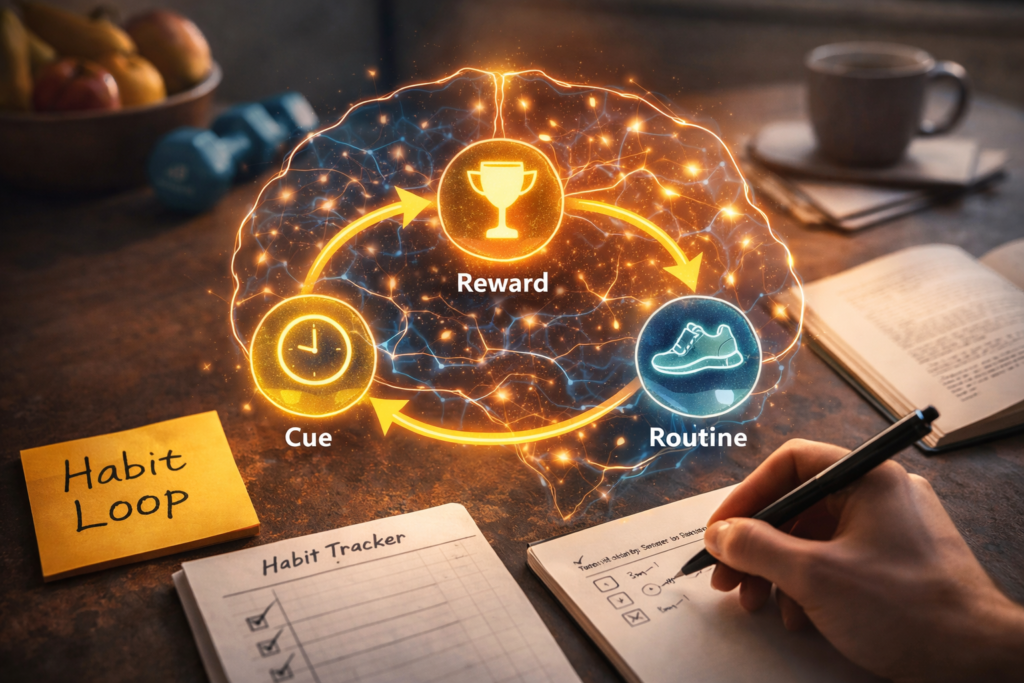
3. Use the “Focus Trigger”
Your brain learns through repetition.
Create a ritual.
Example:
- Same place
- Same time
- Same action
Over time, your brain associates that with focus.
4. Make Distraction Hard (Environment Design)
This is one of the most powerful strategies.
From behavioral science:
Environment beats discipline.
Practical changes:
- Phone in another room
- Website blockers
- Clean desk
Small changes → big impact
5. Build “Effort Tolerance”
Right now, your brain avoids effort.
You need to reverse that.
How:
- Do hard things daily
- Even when you don’t feel like it
Examples:
- Read without checking your phone
- Work without switching tabs
- Sit in silence
This concept connects with
👉 Atomic Habits
Small repeated actions reshape identity.
Real Story: From Distracted to Focused
A common pattern seen in high performers:
They weren’t always focused.
They trained it.
Many programmers, writers, and entrepreneurs report:
- Initial struggle with distraction
- Gradual improvement through routine
- Deep focus becoming natural over time
Focus is built—not inherited.
Practical System (Do This for 7 Days)
Step 1: Choose one task
Work, study, writing
Step 2: Set timer
25 minutes
Step 3: Remove distractions
Phone away, tabs closed
Step 4: Focus fully
Step 5: Repeat daily
After 7 days:
- Focus improves
- Resistance decreases
- Confidence increases
Why This Works
You’re doing 3 things:
- Training your brain
- Reducing dopamine overload
- Building identity
Final Thoughts
You don’t lack focus.
You’ve been trained to be distracted.
But the opposite is also true:
👉 You can train yourself to focus.
Start small.
Reduce distractions.
Repeat daily.
Over time:
Focus stops being hard…
And becomes who you are.