
Staying consistent is one of the biggest challenges people face when trying to improve their lives.
You start motivated. You create a plan. You take action for a few days…
And then—life happens.
You lose momentum, skip a day, and suddenly everything falls apart.
But here’s the truth most people don’t realize:
Consistency is not about motivation. It’s about systems, identity, and brain conditioning.
In this guide, you’ll learn a science-backed system to stay consistent long-term—even when you don’t feel like it.
Why Consistency Is So Hard (Scientific Explanation)
From a neuroscience perspective, your brain is designed to save energy, not to pursue long-term goals.
The brain prefers:
- Immediate rewards
- Low effort
- Familiar behaviors
This is controlled by structures like the basal ganglia, which automate habits, and the prefrontal cortex, responsible for decision-making (but easily fatigued).
What this means in practice:
- You want to work out → brain resists effort
- You plan to focus → brain seeks distraction
- You decide to be consistent → brain defaults to old habits
This is why willpower alone fails.
The Real Secret: Systems Over Motivation
One of the most important concepts in behavior science is:
You don’t rise to your goals. You fall to your systems.
This principle is deeply explored in
👉 Atomic Habits
James Clear explains that lasting consistency comes from repeatable systems, not bursts of motivation.
Example:
❌ Goal-based thinking:
“I want to exercise 5 times a week”
✅ System-based thinking:
“I will exercise for 10 minutes every day after waking up”
The system removes decision-making—and that’s where consistency is built.
SEO Insight: What Builds Long-Term Consistency?
(Important for ranking + reader engagement)
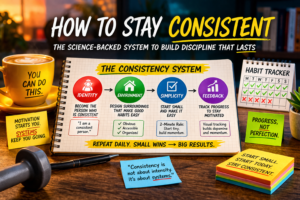
Consistency is built through 4 pillars:
- Identity
- Environment
- Simplicity
- Feedback
Let’s break each one down.
1. Identity: Become the Person Who Is Consistent
Research in psychology shows that behavior change is more effective when tied to identity.
This idea is strongly supported in
👉 Mindset
Instead of saying:
- “I want to be consistent”
Say:
- “I am a consistent person”
Every action reinforces identity.
Why this works:
Your brain seeks alignment between behavior and self-image.
🧠 Practical Exercise:
Write this down:
“I am the type of person who __________ daily.”
Example:
- “I am the type of person who trains daily”
- “I am the type of person who focuses deeply”
Repeat it daily.
2. Environment: The Hidden Force Behind Consistency
Most people underestimate this.
Your environment dictates behavior more than motivation.
Scientific insight:
Behavior is often triggered by visual cues.
Optimize your environment:
Make good habits obvious:
- Leave your book on your desk
- Keep water visible
- Prepare workout clothes
Make bad habits invisible:
- Remove apps from home screen
- Keep distractions out of reach
Environment design reduces the need for discipline.
3. Simplicity: Why Small Habits Win
The brain resists effort—but accepts small actions.
This is known as behavioral friction.
The lower the friction, the higher the consistency.
Use the “2-Minute Rule”:
- Read → 1 page
- Workout → 2 minutes
- Write → 1 paragraph
This principle is widely reinforced in
👉 The Power of Habit
🧠 Practical Exercise:
Choose one habit and simplify it:
Instead of:
“I will work out 1 hour”
Use:
“I will do 5 minutes”
Consistency first. Intensity later.
4. Feedback: The Missing Piece Most People Ignore
Your brain needs evidence of progress.
Without feedback:
- Motivation drops
- Effort feels pointless
- Habits disappear
Use visual tracking:
- Habit tracker
- Calendar streak
- Checklist
Why it works:
Progress triggers dopamine → reinforces behavior
The Dopamine-Consistency Connection
Dopamine plays a critical role in habit formation.
But here’s the key insight:
Dopamine is driven by progress, not perfection.
Every small win:
- Increases motivation
- Strengthens habit loops
- Builds consistency
This concept aligns with research explored in
👉 Dopamine Nation
Common Mistakes That Destroy Consistency
Avoid these if you want long-term results:
1. Starting too big
Leads to burnout
2. Relying on motivation
Motivation is unstable
3. Skipping after failure
Breaks identity
4. No system in place
Creates inconsistency
The “Never Miss Twice” Rule
One of the most powerful strategies:
Missing once is a mistake. Missing twice is the start of a new habit.
This rule protects your consistency.
🧠 Micro-Action Plan:
If you fail:
- Don’t overthink
- Don’t restart next week
- Restart immediately
Advanced Strategy: Habit Compounding
Small actions repeated daily create exponential results.
This is called compound growth.
Example:
1% improvement daily = massive transformation over time
This principle is the foundation of long-term success.
Final Thoughts
Consistency is not built through intensity—it’s built through repetition, simplicity, and system design.
If you rely on motivation, you will fail.
If you build systems, you will succeed.
Start today:
- Choose one small habit
- Make it easy
- Track it
- Repeat daily
Over time, your actions become automatic—and consistency becomes part of who you are.