

We live in an era of constant interruptions. Notifications, emails, social media, endless tabs, and instant messages compete for our attention every minute of the day. As a result, many people struggle to focus deeply on important tasks.
The ability to concentrate for long periods—often called deep work—is becoming increasingly rare. But at the same time, it is becoming one of the most valuable skills in the modern world.
People who can focus deeply produce better work, learn faster, and create more meaningful results in less time. The challenge is that deep focus doesn’t happen naturally anymore—it must be trained intentionally.
In this article, we will explore what deep work really is, why it matters, what prevents us from doing it, and how you can train your brain to concentrate deeply again.
What Is Deep Work?
The concept of deep work was popularized by author Cal Newport. It refers to the ability to focus on cognitively demanding tasks without distraction. During deep work, your mind operates at full capacity, allowing you to produce high-quality results and solve complex problems.
Examples of deep work include:
- Writing an article or research paper
- Learning a complex new skill
- Programming or developing software
- Strategic planning and problem-solving
- Creating art, music, or design work
Deep work is different from shallow work, which consists of tasks that require little mental effort and are often performed while distracted.
Examples of shallow work include:
- Checking emails
- Responding to messages
- Attending unnecessary meetings
- Browsing social media
- Organizing files or documents
While shallow tasks are necessary, they should not dominate your day.
Why Deep Work Is Becoming Rare
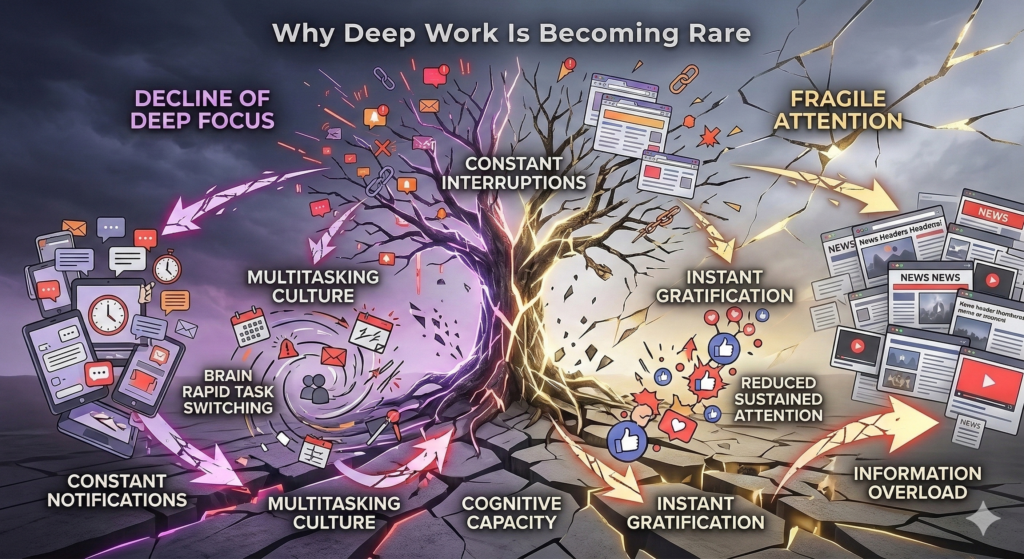
Modern technology has dramatically changed how we interact with information. Many digital platforms are designed to keep us constantly engaged, switching from one stimulus to another.
Several factors contribute to the decline of deep focus.
1. Constant Notifications
Every notification interrupts your attention. Even a quick glance at your phone can break your concentration and make it difficult to return to the original task.
Research shows that it can take more than 20 minutes to fully regain focus after an interruption.
2. Multitasking Culture
Many people believe multitasking makes them more productive. In reality, the brain cannot perform multiple cognitive tasks simultaneously. Instead, it rapidly switches between tasks, which reduces efficiency and increases mistakes.
3. Instant Gratification
Social media platforms train our brains to seek quick rewards—likes, messages, videos, and updates. Over time, this reduces our tolerance for slower, more demanding activities that require sustained attention.
4. Information Overload
We consume more information today than at any other time in history. Constant exposure to news, videos, and online content overwhelms our mental capacity and makes it harder to concentrate deeply.
The Benefits of Deep Work
Despite the challenges, cultivating deep focus offers powerful advantages.
Higher Quality Work
Deep concentration allows you to process information more thoroughly and produce higher-quality results. Instead of rushing through tasks, you can think critically and creatively.
Faster Skill Development
Learning requires focused attention. When you practice a skill without distraction, your brain forms stronger neural connections, allowing you to improve more quickly.
Increased Productivity
Deep work reduces the time needed to complete complex tasks. One hour of intense focus can accomplish more than several hours of distracted work.
Greater Mental Satisfaction
Working deeply can produce a sense of flow—a state where you become fully immersed in an activity. During flow, time seems to pass quickly, and the work itself becomes rewarding.
How to Train Your Brain for Deep Focus
Deep focus is not simply a matter of willpower. It requires training your mind and designing your environment to support concentration.
Here are several strategies that can help.
1. Schedule Dedicated Focus Blocks
Deep work rarely happens by accident. It must be scheduled intentionally.
Instead of trying to focus all day, designate specific periods for deep work. Many experts recommend 60 to 90 minute focus sessions.
During this time:
- Turn off notifications
- Close unnecessary tabs
- Avoid checking your phone
- Work on only one task
By repeating these sessions regularly, your brain learns to associate certain times with deep concentration.
2. Reduce Digital Distractions
Technology is one of the biggest obstacles to focus. Limiting distractions can dramatically improve your ability to concentrate.
Some practical steps include:
- Turning off nonessential notifications
- Keeping your phone in another room
- Using website blockers during work sessions
- Closing email and messaging apps
Even small changes can significantly reduce interruptions.
3. Create a Focus-Friendly Environment
Your physical environment influences your mental state.
A cluttered, noisy workspace makes it harder to concentrate, while a calm, organized space encourages focus.
Consider:
- Decluttering your desk
- Using noise-canceling headphones
- Playing instrumental or ambient music
- Working in a quiet area
Over time, your brain begins to associate this environment with concentration.
4. Train Your Attention Like a Muscle
Focus improves with practice, just like physical strength.
If you currently struggle to concentrate for long periods, start with shorter sessions.
For example:
Week 1: 20 minutes of focused work
Week 2: 30 minutes
Week 3: 45 minutes
Week 4: 60 minutes
Gradually increasing the duration helps your brain adapt.
5. Embrace Boredom
One of the biggest enemies of focus is our constant desire for stimulation.
Whenever we feel even slightly bored, we reach for our phones. This habit trains our brains to expect constant entertainment.
To reverse this pattern, allow yourself to experience boredom occasionally. For example:
- Wait in line without checking your phone
- Take a walk without listening to music or podcasts
- Sit quietly for a few minutes
Learning to tolerate boredom strengthens your ability to concentrate.
6. Prioritize High-Value Tasks
Not all tasks deserve deep focus.
Reserve your best mental energy for work that truly matters—tasks that require creativity, strategy, or learning.
Administrative tasks and routine work can be scheduled later in the day when your energy is lower.
This ensures your most valuable cognitive resources are used effectively.
7. Protect Your Energy
Deep focus requires mental energy, and energy is influenced by several factors:
- Sleep quality
- Physical activity
- Nutrition
- Stress levels
Poor sleep or constant stress can make deep concentration almost impossible.
Taking care of your physical well-being supports your cognitive performance.
Final Thoughts
In a world designed to distract you, the ability to focus deeply is becoming a superpower. While many people allow their attention to be fragmented by endless notifications and shallow tasks, those who cultivate deep focus gain a powerful advantage.
Training your brain for deep work takes time and consistency. But the rewards are significant: better results, faster learning, greater creativity, and a stronger sense of purpose in your work.
Start small. Schedule one focused session each day. Remove distractions. Protect your attention.
Over time, your mind will become stronger, clearer, and capable of producing work that truly matters.